I wrote a version of this article in Dutch a few weeks ago. Since then I spent a full day in Paris with some European colleagues and friends from both HL7 and MyHealth@EU, and what I heard there made me want to write it again, in English, for a wider group. The argument has not changed. It has become more urgent and we can work together on this. What follows is my own reading of it, not a position of any of the programmes I work for.
The conversation about cross-border health data exchange is almost always a conversation about structure. CDA or FHIR. Which resources, which profiles, which implementation guide. That is the half we have tooling for, and honestly it is the half people enjoy creating.
The semantic half is where I keep getting stuck, and it is also where my Dutch version of this piece ended up: the hard part is not FHIR or CDA, it is the codes.
Our national code systems do not map cleanly onto the European ones that cross-border exchange requires. Some concepts transcode easily. Many do not. For each of those, somebody has to make a decision that requires understanding both the clinical meaning and both code systems. And that decision then has to be recorded in a way a machine can act on.
That is not developer work. It cannot be generated. And it is almost always underestimated in planning, because from a distance it looks like configuration but is far more complicated.
What Paris added
The migration from CDA to FHIR was the centre of gravity in the Semantic Community session. Two things struck me.
The first is that this is really two separate changes, not one. The content of a message and the transport around it can migrate independently. Content first, transport first, or both at once. Every scenario on the table comes from that one fact, and it is worth understanding before anyone commits to a date.
The second is the question Europe has not answered yet. Exchange takes two parties. When one speaks the old format and the other speaks the new one, who absorbs the difference? The receiver, who would then have to understand both? The sender, who delivers whatever the other side can handle? Or nobody, in which case we fall back on a PDF that a clinician can read and a system cannot process.
Member states already in production were clear that a short cutover is not realistic for them. Which means the transition period is likely to be measured in years rather than weeks, and that its length will be set by the countries furthest along, not by the ones building on their first releases for cross-border exchange.
Here is why that belongs in an article about terminology. All three answers to the mismatch question are structural on the surface and semantic underneath. Whichever one Europe picks, somebody still has to decide what a national code means in European terms. Falling back on PDF does not avoid that work, it moves the cost onto the clinician, who now retypes it.
On sharing translations, which is the right instinct and harder than it sounds
There was a call in Paris for member states to share their translations with each other. The reasoning is sound and I agree with the premise. Dutch and Flemish, French and Belgian French, German and Austrian and Swiss German/French: there is obvious overlap, and work paid for with public money should be shared by default rather than rebuilt behind every border.
But language is not the hard part, and I think we should be precise about why.
A translation can be linguistically correct and still be wrong. Our health systems differ, and a code carries more than its label. It carries assumptions about who delivers the care, in what setting, under which organisational arrangement, and often about how that care was historically funded and recorded. Two countries can have a term that translates perfectly and a concept that does not overlap.
That is the real risk. Transcoding looks like translation, which makes it feel safe to reuse. It is not translation. It is a judgement about whether two concepts mean the same thing in two different systems of care, and when that judgement is wrong it does not announce itself. It surfaces years later as a data quality problem, at which point nobody remembers which mapping decision caused it.
There is a second complication, less discussed and worth naming. Not all of this can simply be made open. Many national code systems were built over decades, funded from budgets that had nothing to do with European exchange, with organisations around them that have their own intellectual property and their own legitimate interests. The principle that publicly funded work should be shared is right. It does not follow automatically that every derived transcoding can be published as open content. That needs to be resolved deliberately, per code system, carefully weighing the risks, rather than assumed away in a call for openness.
Which is the broader point. Taking a national code system that works well at home and making it fit for EHDS is not mainly a technical exercise.
Two things I want to make explicit
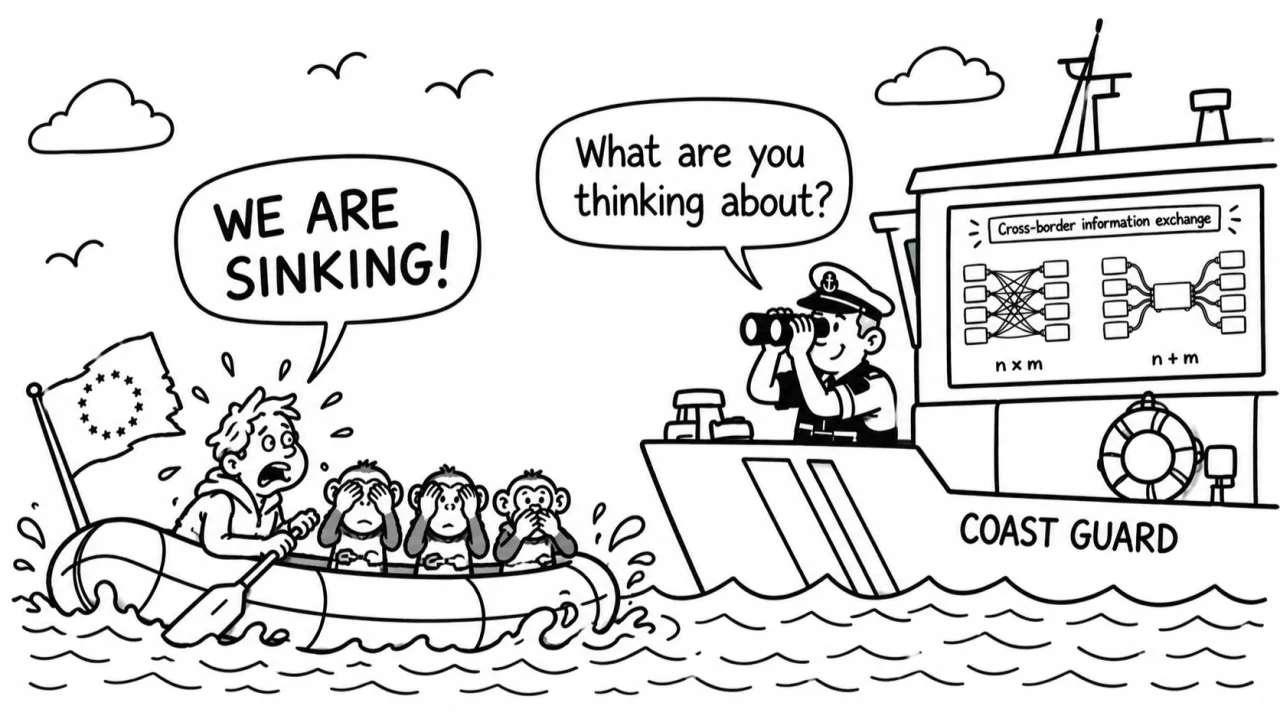
First, this argues -again- for one shared version in the middle. Rather than mapping every national format onto every other one, everyone maps to that same shared version. With four formats on each side, that is 8 mappings instead of 16. Adding a format then costs 2 instead of 8. The arithmetic is not complicated, but it lands better as a picture than as a sentence. It also gives the sharing question a sensible shape: what you share is your mapping to the middle, along with the reasoning behind it, rather than a bilateral translation that quietly assumes your system and mine work the same way.
Second, and this is the point I would most like to see made. Those semantic mappings are largely independent of the structural format you start from. A national code is still a national code, whether it arrives inside a CDA document or a FHIR resource. That work sits on the critical path regardless of which migration route is chosen. Which seems a good reason to start it early rather than treat it as a by-product of the build.
And it is a particularly good reason now. If the transition really does run for years, the countries that treated terminology as a downstream detail will spend that entire period discovering it was not.
The structural mapping fragments are reusable. A library of them, built and maintained together rather than country by country, seems obviously worth the effort. So does sharing the reasoning behind mapping decisions, which is arguably more valuable than the mappings themselves and much rarer.
Written in a personal capacity. Originally published on LinkedIn.
